
A Teapot Changed the Way I Thought About Design
I originally went to college to study art. Painting, specifically.
I've always loved art. The creativity, imagination, expression, and freedom to create something simply because you have a vision for it. There's something special about bringing an idea to life without necessarily having to justify its existence beyond the artistic expression itself.
But during an art history class in college, I learned a lesson that fundamentally changed how I thought about creativity and eventually shaped the direction of my career.
Each week, a different instructor from the art department would visit our class to introduce their discipline and discuss their approach to creative work. One week, the graphic design professor, Barry Buxcamper, came to speak.
He shared an illustration that has stayed with me ever since.
Imagine creating a teapot.
Not an ordinary teapot, but an extraordinary work of art. The spout curves upward with a beautiful flower blooming from its opening. The sides feature intricate engravings and decorative cutouts. The handle extends gracefully upward before twisting downward, reaching the floor, and melting into a puddle of metal.
It could be beautiful. Imaginative. Provocative. A remarkable expression of artistic creativity. And as a piece of art, it could be an extraordinary success.
But as a piece of design?
It would be a failure.
You couldn't pour tea from it. The cutouts would allow the liquid to spill everywhere. The handle would make it impossible to pick up. The very elements that make it an interesting work of art prevent it from accomplishing its intended purpose.
That was the distinction he wanted us to understand.
Art can succeed through expression alone. Design has to accomplish something.
It's a simple concept, but it completely changed how I viewed the creative process. And as my career evolved from graphic design into creative leadership, branding, marketing, and business strategy, I came to understand just how much that lesson extends beyond the functionality of a teapot.
Beautiful Isn't Always Effective
A designer can create something visually stunning. The typography can be beautiful, the colors perfectly balanced, the imagery compelling, and the composition expertly executed.
But what happens if nobody understands the message? What if the design doesn't connect with the intended audience? What if the customer doesn't understand the product's value? What if the website looks incredible but visitors can't figure out what they're supposed to do next?
What if the advertisement wins creative awards but doesn't convince anyone to buy? Then what has the design actually accomplished?
This is where I believe the distinction between art and commercial design becomes especially important.
Art has the freedom to exist for expression. It can challenge, provoke, inspire, or invite interpretation without requiring a specific response from the viewer.
Design, particularly in a business environment, carries additional responsibilities. There's a message to communicate, a product to sell, a service to explain, an audience to reach, or a problem to solve.
The creative execution has to support those objectives.
Looking good isn't enough. The design has to work.
But Functionality Isn't Enough, Either
Let's return to that teapot for a moment.
Suppose we create another teapot. This one pours perfectly. The handle is comfortable. It holds the right amount of liquid and doesn't spill a drop. Functionally, it's a success.
But what if it's completely unappealing? What if nobody finds it attractive or interesting? What if it sits on a shelf surrounded by competing products that accomplish the exact same thing, but those products are more desirable?
Our teapot works perfectly, but nobody wants to buy it. Have we succeeded?
Now imagine that we've created a beautifully designed teapot that works flawlessly, but it's so expensive to manufacture that the company can't sell it profitably.
We've satisfied the artist and the user, but we've failed the business.
This is where design becomes something far more interesting than aesthetics or functionality alone. It has to account for the realities of the organization investing in it.
Revenue. Expenses. Profitability. Market positioning. Customer acquisition. Competition. Return on investment.
And that's where we arrive at what I consider the intersection of art and business.
Where Art Meets Business
Art brings creativity, imagination, emotion, aesthetics, and expression.
Business brings strategy, financial objectives, operational realities, growth expectations, and the need for measurable results.
Design lives at the intersection of the two.
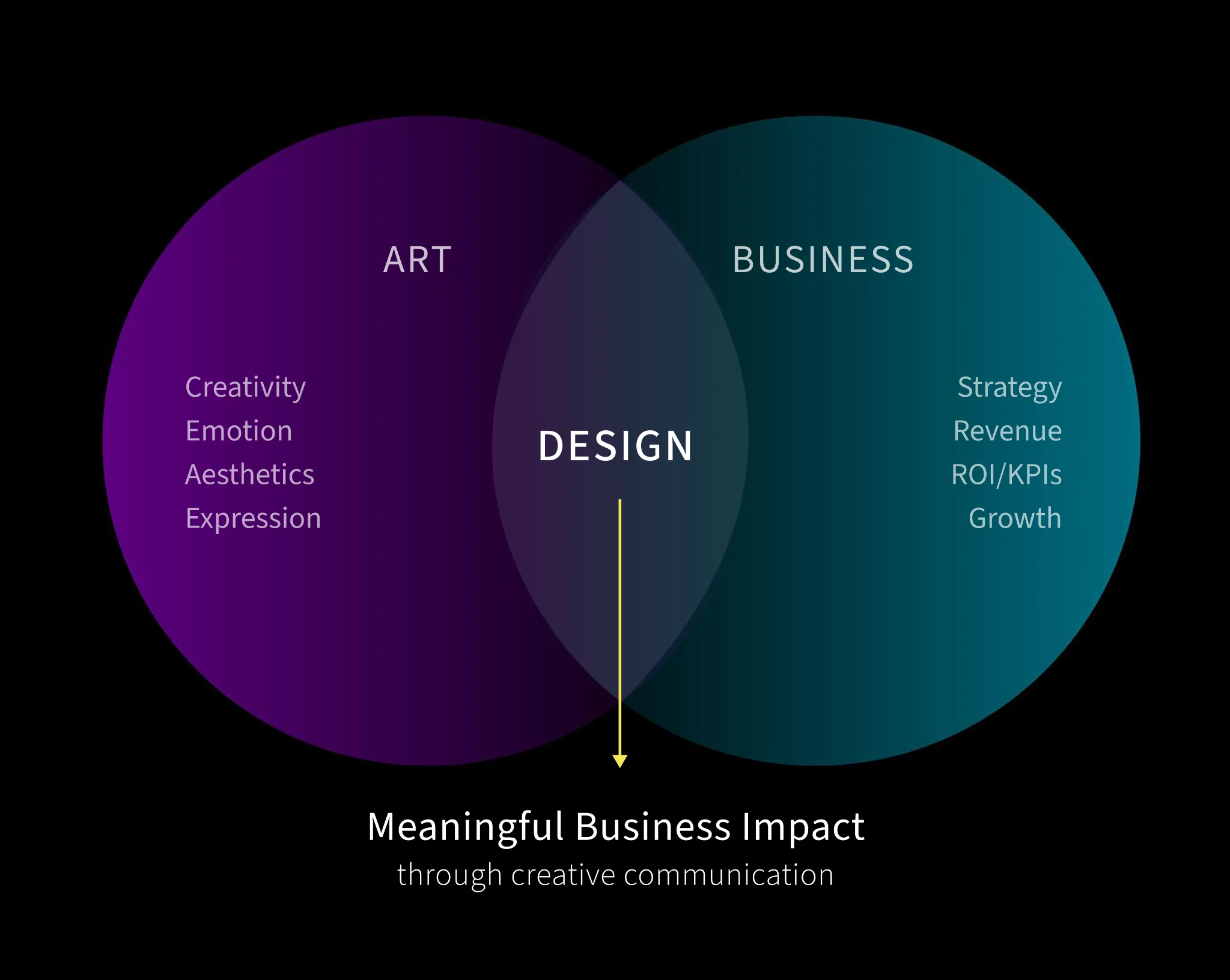
Its responsibility is to bring creative thinking to the challenges a business needs to solve.
Sometimes that's generating sales or increasing leads. Sometimes it's building trust, improving the customer experience, communicating a complicated service, or helping a brand stand apart from its competitors.
The purpose changes depending on the problem, but the responsibility remains the same. The creative execution has to contribute to the desired outcome.
And yet, the artistic side can't be dismissed as decoration or an unnecessary luxury.
People don't make decisions based solely on information. They respond to emotion, perception, familiarity, credibility, aspiration, and trust. How something looks, feels, and communicates influences what people believe about it.
That matters when someone is deciding which product to purchase, which organization to support, or which service provider to trust.
Good design connects those emotional responses to the practical objectives of the business. It's not about choosing between creativity and performance.
It's about understanding how creativity can drive performance.
The Challenge Is What Makes Me Love Design
And this is precisely what I've come to love most about design.
I love art. I always have. But what fascinates me about design is the challenge of taking those same creative instincts and applying them to something that has to accomplish a specific purpose.
There are objectives to meet. Problems to solve. Audiences to understand. Budgets to consider. Limitations to work within. And expectations about what the work ultimately needs to achieve.
For me, those constraints don't diminish creativity. They make the creative process more interesting.
It's one thing to create something beautiful when the primary objective is artistic expression. It's another to create something beautiful that also explains a complicated idea, changes someone's perception, influences a decision, or helps a business grow.
And that's where my love of design becomes inseparable from my love of marketing.
Marketing introduces another layer to the challenge.
Who are we trying to reach? What motivates them? What do they care about? What problems are they trying to solve? Why would they choose one company over another? What's preventing them from taking action?
And how do we reach them with a message that actually resonates?
Design helps bring those answers to life.
Marketing provides insight into the audience, the market, and the opportunity. Design translates that understanding into something people can see, experience, understand, and respond to.
And the relationship works in both directions. Creative thinking can reveal opportunities, challenge assumptions, and help shape the marketing strategy itself.
They're not separate disciplines working independently. They're interconnected parts of the same process.
That's the challenge I enjoy. Not simply creating something that looks good, but figuring out how to make it look good, communicate effectively, connect with the right people, and produce a meaningful result.
That's what makes the work exciting.
Design Deserves a Seat at the Business Table
One of the frustrations I've encountered throughout my career is how often design is treated as something that happens after the important decisions have already been made.
The business identifies a problem, decides what it wants to say, establishes its objectives, and then brings in a designer to make everything look good.
But that approach overlooks what experienced creative professionals can contribute.
Design isn't simply the visual packaging of a strategy developed elsewhere. It can help shape the strategy itself.
A designer who understands the business can identify weaknesses in how a product is presented, opportunities to reach an overlooked audience, or barriers preventing customers from taking action.
Sometimes the problem isn't that a website looks outdated. It's that visitors don't understand why they should choose that company.
Sometimes an advertisement doesn't need better photography or a more exciting headline. It needs a stronger offer.
Sometimes a business doesn't need more attention. It needs to convert the attention it's already receiving into customers.
These are business challenges, and creative thinking can play an important role in solving them.
It's also why design decisions shouldn't be evaluated solely through personal preferences.
Whether an executive likes a particular color or someone on the marketing team prefers a different layout is far less important than whether the design is effective for its intended audience.
The questions should be: Does it communicate clearly? Does it connect with the right people? Does it support the business objective? Does it encourage the desired action?
And ultimately, is it contributing to the success of the organization?
Not every design outcome can be reduced to an immediate sale or a single KPI. Brand perception, trust, and customer relationships can develop over time.
But every design decision should serve an intentional purpose.
The Intersection Is Where the Value Lives
I still think about Barry Buxcamper's teapot.
What started as a simple illustration in a college classroom has become a guiding principle in how I approach creative work.
Art taught me to appreciate imagination, expression, and the emotional power of something beautifully created.
Design taught me that creativity becomes even more powerful when it serves a purpose.
And marketing and business strategy taught me to look beyond the finished creative and consider what it actually accomplishes.
A beautiful teapot that can't pour tea may be a wonderful work of art.
A perfectly functional teapot that nobody wants may be an engineering success but a commercial failure.
But a teapot that's beautiful, functional, desirable, and economically viable?
That's where design demonstrates its full value.
For me, that's the intersection of art and commerce.
The best design doesn't just capture attention or look beautiful. It connects with people, solves problems, influences decisions, and helps businesses achieve something meaningful.
And that's what makes the challenge worth pursuing.
Have a project in mind?
We help Middle Tennessee businesses build brands and websites that bring in the right customers. Let's talk about yours.
Start a Project